
Your pink licence gives you experience. What shows it is developing you?
When a learner tells you they have ADHD, what happens next in your head? For some instructors, a set of assumptions arrives immediately. The learner will be impulsive, easily distracted, risky. For others, the opposite: the label is treated as irrelevant and nothing changes.
Both responses skip the work that actually helps the learner.
What the review found
A rapid review published on 23 September looked at ADHD and driving. It found eight studies: five non-randomised simulator studies and three observational studies. The simulator findings were contradictory. The observational findings were mixed. A firm comparison with drivers without ADHD could not be made.
The practical reading is straightforward. A diagnosis alone is an unreliable basis for predicting how an individual learner will drive. People with the same diagnosis differ enormously, and the research does not give us a dependable profile to apply.
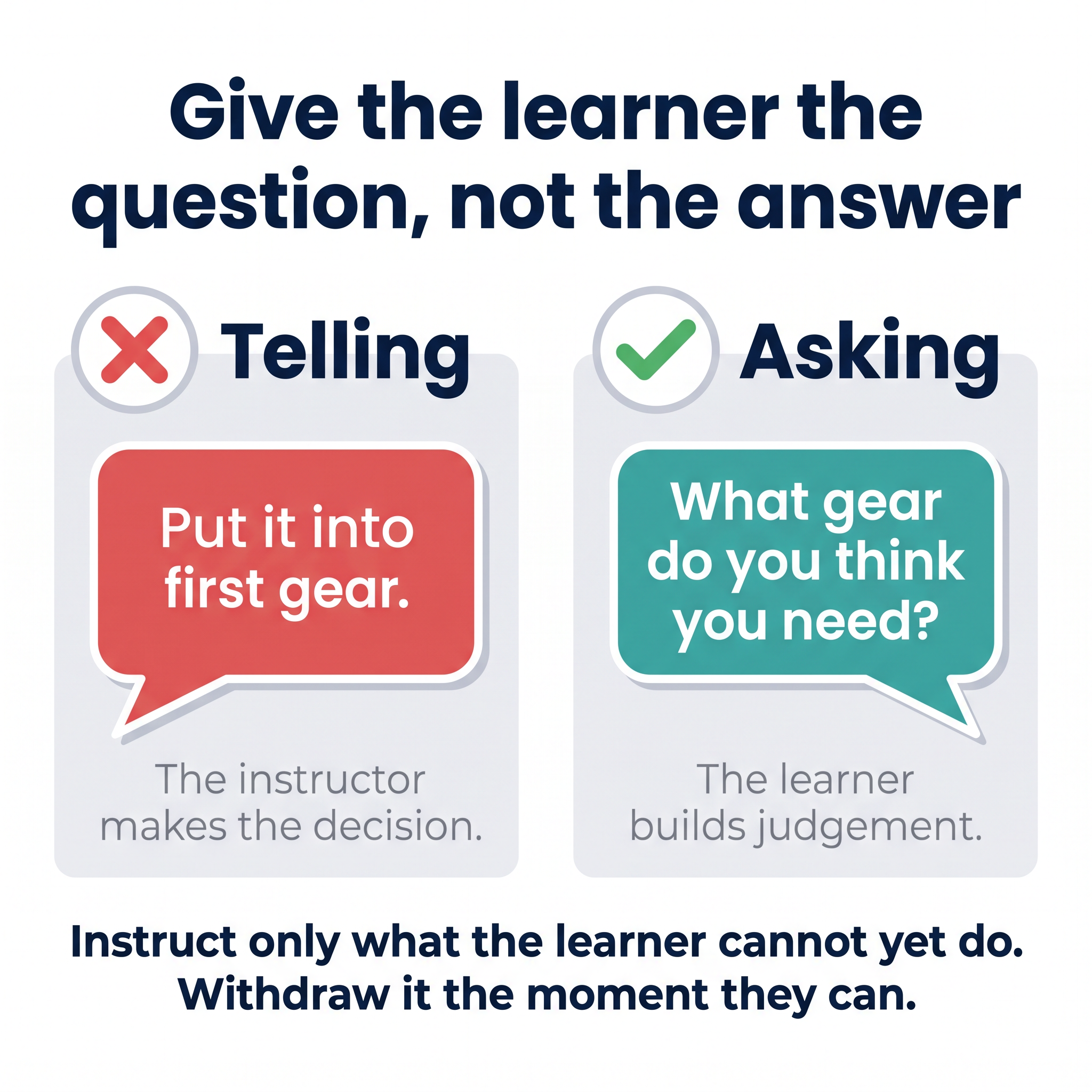
Why assumption is the real problem
Assumption feels like professionalism, because it looks like knowledge. But it can fail in two directions.
If you assume difficulty, you may over-support, lower expectations, or talk down to a learner who is perfectly capable in most situations. If you assume no difficulty, you may miss a real pattern that needs a change in how you teach.
Neither is a decision based on this learner, in this car, on this road.
Separate four things
A more useful habit is to keep apart what you know from what you see.
What the learner tells you. A diagnosis, a strategy they use, a past difficulty. This is information worth having. It is not a prediction.
What you observe. Behaviour in the car, in specific situations, noted at the time.
Where difficulty appears. Often it is not constant. It may show in busy junctions, in long explanations, when two things need attention at once, or when a lesson changes without warning.
What helps. A shorter briefing, a different pace, fewer simultaneous demands, a written prompt, a planned break. And, importantly, what evidence you would need before reducing that support.
Try this: an observation sheet
You can set up a simple sheet for any learner, not only those with a diagnosis. Use five headings:
· Context. Where, when, traffic level, fatigue, time of day.
· Instructional load. How much you were asking them to take in at that moment.
· Divided-attention demands. What else was competing for their attention: a junction, a pedestrian, a new instruction, a navigation task.
· Learner strategy. What did they do to cope? Did they slow down, ask for repetition, stop, push through?
· Performance. What actually happened, described factually.
Complete it after two or three lessons where something stood out. Look for patterns across the entries, not a single verdict from one bad day. If you want to make this into a downloadable template for your own business, these five headings are a good base.
Then agree a change with the learner. Reduce one demand, such as giving instructions earlier or one at a time, and see what happens. Record the result. Only withdraw support when the record shows the learner managing without it.
Treat the learner as the expert on their own experience, and yourself as the person responsible for noticing what they cannot easily see.
How strong is the evidence?
Limited, and I want to be plain about it. The review covered only eight studies, which were heterogeneous, and the search ran to January 2025. The simulator work was not randomised. Nothing here lets us say how any particular learner with ADHD will drive.
The observation framework above is my own practical suggestion, built from the review's message that individual observation beats diagnosis. It is not a validated tool, and I have not tested it. It is a structured way of doing what good instructors already try to do.
Nothing here replaces advice from a learner's clinician or from the relevant licensing authority on medical fitness to drive.
The takeaway
Know what you have been told, record what you see, and be honest about the gap between them. The learner in front of you deserves to be taught as an individual, not as a label.
If you are interested in further development on teaching a wide range of learners, there is more material available elsewhere on this site.